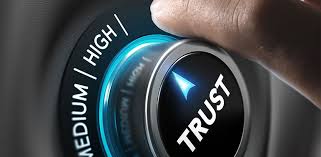
 Trust is not a singular concept in nature. I have studied trust for several decades, teach it in several settings, and written four books on it. Trust is such a common word that we use it numerous times a day without thinking. Just listen to the advertisements on TV and you will hear the word trust in the majority of them.
Trust is much broader than we think
Many people have a misconception about the concept of trust. They think of trust as a singular concept when using the word in daily conversation. They picture it as a kind of bond between them and another person. It takes on a singular connotation. Either they trust another person or do not trust him or her at some level right now.
Trying to define the word
The way I get groups to think about trust more deeply is by asking what the word means. There is always a pause and awkward silence for a few seconds as people try to define it. Then, someone will offer that trust is the confidence that another person will perform in a certain way. Someone else will chime in that trust is taking a risk that they could be disappointed. A third person will add that trust is about having shared values. Then someone will add that trust is having their back or sticking up for them. Once the ball gets rolling, a group can come up with a couple dozen definitions of trust quickly.
Trust is ubiquitous
Now the group is ready to entertain the idea that trust is a multi-faceted concept. It exists not only between people, but with organizations, products, services, and all kinds of systems. People get the idea that trust is ubiquitous and is all around them in every moment of their day. They recognize that before they get to work in the morning, they have experienced trust several hundred times.
We trust systems to work
They walk into the bathroom and turn on the lights. They trust the whole system to provide light. They don’t think about where the electricity is coming from unless there is some kind of rare failure.
They turn on the water and just expect potable water to come out without any problem. If it is the left faucet, they trust that the water will become warm, then hot with time. By the time they reach the breakfast table, trust is experienced dozens of times; then things get really complicated.
Medications require trust
At breakfast, they are confident that the vitamin pill they are taking is safe. They have no idea who made the pill and what ingredients went into it. They just swallow the pill and expect it to help.
In the car
They get into their car and turn the ignition key. Now, inside the engine, there are thousands of explosions each minute that allow the car to move. They peacefully enjoy the classical music on their favorite station and crank up the air conditioning.
They have no worry when they press down on the brakes that the car will stop. They drive over numerous bridges and overpasses without blinking an eye. They do not think of the consequences if the structure would become unsafe.
Just a few examples to illustrate
On it goes all day every day that they simply take for granted things will work as designed. They recognize on occasion things might fail for some obscure reason. The failures are so remote that they put them out of their mind unless something unusual is going on. Now let’s focus on how trust between people is built and lost for all of us.
In general, we all focus our conscious energy on trust in the relationships we have with other people. Often we forget about the transactional nature of trust. It is impacted by everything (seen and unseen) that happens between people.
Trust is always bilateral
Trust is bilateral. I trust you and you trust me at some level, and the levels are not the same. Something happens, and I may trust you more while you trust me less. The whole thing is dynamic and constant. Most of the trust interactions are going on in our subconscious minds. We have a kind of score card in our mind that is like the balance in a bank account.
A bank account
Many authors, including me, have likened trust to a bank account. We have a balance, and we make deposits and withdrawals. The size of the deposit or withdrawal will vary depending on what is happening. The transaction may be totally subconscious. We can make a huge withdrawal of trust with another person and be totally oblivious to it.
A few years ago I built a model that helps people visualize this trust account and how it works. I call it my “Trust Barometer” and show it at all my programs. People really get the message about how trust works very easily. Here is a link to a Trust Barometer Video (6 minutes) about how trust is built and lost. Take a peek at this fun description and see if it helps you picture the nature of trust in your life.
Conclusion
Trust is more complex and ubiquitous in our lives than we realize. Try to be more aware of this aspect of trust. You can see it working for you more consciously on a daily basis. It is fun, and it certainly is an eye-opener.
Bob Whipple, MBA, CPTD, is a consultant, trainer, speaker, and author in the areas of leadership and trust. He is the author of The Trust Factor: Advanced Leadership for Professionals, Understanding E-Body Language: Building Trust Online, and Leading with Trust is Like Sailing Downwind. Bob has many years as a senior executive with a Fortune 500 Company and with non-profit organizations


 Posted by trustambassador
  To experience maximum trust with people we know, we need to be aware of the transactional nature of trust. Everything that happens between us will have some impact on the level of trust.
 I was having an online conversation about jokes and teams at work. The discussion was relative to having online messages misinterpreted. Clearly, we have all experienced this uncomfortable situation more than once. I got so fascinated about this topic that I wrote a book on it a few years ago.
  It is pretty obvious that trust and ethics are related. You may not have thought about the relationship in a conscious way. This article shines a light on that. It offers an example of how a community can change ethical conditions for the better.
 Few leaders are capable of accepting accountability. I work with leaders every week and focus on helping them build higher trust in their organizations. One observation I have made over the years is that nearly all leaders are passionate about accountability. They make sure people in the organization produce the right things in the right ways.
 The power curve is a critical skill area that my first mentor taught me. I was blessed with a wonderful mentor for most of my career. He and I got along famously, and he taught me a number of leadership skills over the years.
 The behaviors of the senior leaders in any organization will have more impact on trust issues than anything else. Over many years, I have observed how trust in any organization is influenced most by this single factor. If there are trust issues in an organization, leaders need to look in the mirror for the cause.
 You have heard of SMART Goals, but have you ever considered DUMB Goals? SMART stands for Specific, Measurable, Assignable, Realistic, and Time-bound. The term was invented by G.T. Doran in 1981.
 We all would like to see better teamwork where we live and work. The culture of a team governs its effectiveness. Most teams have a culture that allows adequate performance despite many unfortunate outbreaks of tension and sometimes childish behavior. The problems are exacerbated in these uncertain times of hybrid work.
 The power of trust cannot be overstated. It has a huge impact as you experience the transitions of your life. Most human beings go through a kind of ritual when confronting death or other profound change.